Stair nosing
Stair nosing and stair edge trims that protect the front edge of each step, add grip and give stairs a neat, finished look. Anodised aluminium anti-slip nosing, flexible rubber and PVC angle nosing, UPVC in more than 20 wood-effect decors and carpet edge profiles, self-adhesive or screw-fix, in lengths from 90 cm to 2.7 m.
Choose by stair type:
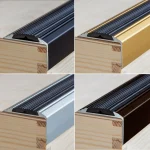
- Aluminium stair nosing: anti-slip, hard-wearing, in silver, gold, champagne, black and inox
- Rubber and PVC anti-slip nosing: flexible angle profiles in black, grey, brown and beige
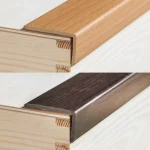
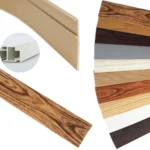
- UPVC wood-effect stair nosing: self-adhesive, to match wooden and laminate stairs
- Stair nosing for carpet: carpet edge profiles for carpeted steps
Stair nosing guide: materials, sizes, fitting & FAQ
What is stair nosing?
Stair nosing is an L-shaped (angle) profile fitted to the front edge of a step. It protects the edge from chipping and wear, covers the cut edge of laminate, wood or vinyl on the tread, and an anti-slip surface makes each step safer. A colour that contrasts with the stairs also makes the edge of each step easier to see.
Which stair nosing should I choose?
- Anodised aluminium: the most durable option, most profiles with an anti-slip top. Best for busy staircases and for laminate or wooden stairs. Available in silver, gold, champagne, black, inox, brown and olive.
- Rubber and PVC: flexible and soft underfoot, with good grip. Ideal for steps and utility stairs, and for edges that are not perfectly straight.
- UPVC wood effect: a budget-friendly, self-adhesive way to finish laminate stairs in a matching oak, walnut, cherry or mahogany decor.
- Carpet stair nosing: edge profiles that hold and protect carpet at the front of each step.
What size stair nosing do I need?
- Length: measure the width of each step. Profiles come in 90 cm, 1.2 m, 1.5 m, 1.8 m and 2.7 m (depending on the type) and are cut to size, so one long length can often cover two narrow steps.
- Profile size: listed as two leg lengths in millimetres, for example 46 × 30 mm. Choose a profile whose legs cover the tread edge and the thickness of your floor covering. The drawing on each product page shows which leg is which.
- Quantity: count every step, plus the top landing edge if it needs finishing.
How to fit stair nosing
- Measure each step and cut the nosing to length. Aluminium cuts cleanly with a fine-tooth hacksaw, and rubber or PVC with a sharp knife.
- Clean the step edge so it is dry and free of dust and grease.
- Self-adhesive: peel off the backing, align the nosing tight to the step edge and press firmly along the full length.
- Screw-fix: hold the nosing in place, mark through the pre-drilled holes, drill, plug if needed and screw down. Many screw-fix nosings come with screws; check the product page.
On stairs, screw-fix gives the most secure, long-lasting fixing. Self-adhesive is quicker and suits lighter use.
Stair nosing FAQ
Is stair nosing anti-slip?
Most of our aluminium nosings are anti-slip profiles, and the rubber and PVC profiles have a grippy surface. Both add traction at the edge of the step, where most slips start.
Can I fit stair nosing on laminate stairs?
Yes. Nosing is the standard way to finish laminate on stairs: it covers the cut edge of the board and protects it. Aluminium or UPVC wood-effect profiles work best.
Can stair nosing be fitted without drilling?
Yes. Choose a self-adhesive version. For heavy daily use, a screw-fix nosing gives the most secure fixing.
What colour stair nosing should I choose?
For a seamless look, match a wood-effect decor to your stairs. For safety, a contrasting colour such as black on light stairs, or silver or gold on dark stairs, makes each step edge stand out.
How many lengths do I need?
One length per step, unless your steps are narrow enough that a longer length can be cut into two. Add one for the top landing edge if needed.


Showing all 16 resultsSorted by popularity
-

Self-Adhesive UPVC Wood Effect Stair Nosing 35mm x 20mm
From £4.35 Inc. VAT Select options This product has multiple variants. The options may be chosen on the product page -

Anodised Aluminium Anti-Slip Stair Nosing 46mm x 30mm
From £5.89 Inc. VAT Select options This product has multiple variants. The options may be chosen on the product page -

Anodised Aluminium Carpet Edge Nosing Profile 22mm x 15mm
£5.24 Inc. VAT Select options This product has multiple variants. The options may be chosen on the product page -

Anodised Aluminium Stair Nosing 35mm x 35mm
From £5.95 Inc. VAT Select options This product has multiple variants. The options may be chosen on the product page -
Self-Adhesive Anodised Aluminium Anti-Slip Stair Nosing 46mm x 30mm
From £6.45 Inc. VAT Select options This product has multiple variants. The options may be chosen on the product page -

Anodised Aluminium Anti-Slip Stair Nosing 35mm x 35mm
From £7.36 Inc. VAT Select options This product has multiple variants. The options may be chosen on the product page -

Anodised Aluminium Anti-Slip Stair Nosing 65mm x 42mm
From £10.79 Inc. VAT Select options This product has multiple variants. The options may be chosen on the product page -

Anodised Aluminium Anti-Slip Stair Nosing 19.5mm x 20mm
£4.45 Inc. VAT Select options This product has multiple variants. The options may be chosen on the product page -

Self-Adhesive Anodised Aluminium Anti-Slip Stair Nosing 25mm x 20mm
From £4.91 Inc. VAT Select options This product has multiple variants. The options may be chosen on the product page -

Anodised Aluminium Carpet Edge Trim 7.9mm x 9mm
From £4.95 Inc. VAT Select options This product has multiple variants. The options may be chosen on the product page -

Anodised Aluminium Anti-Slip Stair Nosing 41mm x 26.6mm
From £6.95 Inc. VAT Select options This product has multiple variants. The options may be chosen on the product page -

Anodised Aluminium Anti-Slip Stair Nosing 40mm x 20mm
From £6.45 Inc. VAT Select options This product has multiple variants. The options may be chosen on the product page -

Anodised Aluminium Carpet Edge Cover Strip 7.9mm x 9mm
£4.41 Inc. VAT Select options This product has multiple variants. The options may be chosen on the product page -

Anodised Aluminium Carpet Edge Trim 7.9mm x 9mm
£4.95 Inc. VAT Select options This product has multiple variants. The options may be chosen on the product page -

Self-Adhesive Anodised Aluminium Anti-Slip Stair Nosing 25mm x 25mm
£5.10 Inc. VAT Select options This product has multiple variants. The options may be chosen on the product page -

UPVC Wood Effect Stair Nosing Trim 1000mm x 35mm x 20mm
£5.24 Inc. VAT Select options This product has multiple variants. The options may be chosen on the product page